
A committee of experts from the textile sector was set up to support the work of the public authorities and contribute to the development of the French environmental labelling scheme. This committee played a key role in ensuring that the latest knowledge in the field of environmental analysis was incorporated, that the proposals put forward were relevant, and that the scheme as a whole was consistent. Unlike the Scientific Council on Food, this committee does not publish opinions or formalised joint positions.
Comprising academic and professional experts from the textile sector and the field of environmental assessment, the committee met six times in 2023 for half-day working sessions. It comprised permanent members, as well as guest experts depending on the topics under discussion.
This committee forms part of a comprehensive approach to the co-development of the methodology. Since 2022, numerous projects and workshops have been carried out on an ongoing basis with industry, civil society, life cycle assessment (LCA) specialists and the academic community, with a view to enriching and refining the methodology. A collaborative platform (the Mattermost Ecobalyse forum) centralises technical discussions. Finally, all progress is regularly presented to the partners’ committee.
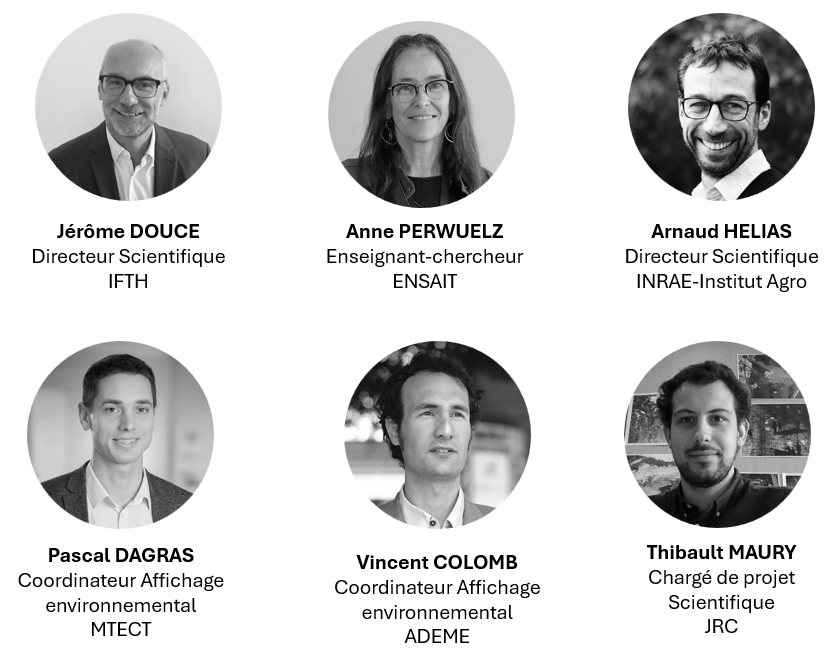
Key guests who contributed to the expert panel:
- Permanent guest: Baptiste Carrière-Pradal (PEF Apparel and Footwear coordinator)
- Physical and non-physical sustainability: Andrée-Anne Lemieux (IFM-Kering Chair in Sustainability), Guillaume Declair (LOOM), Quentin Badonnel (Decathlon)
- Human toxicity and ecotoxicity: Mitch Krauss (Ecotoxicologist, US consultant), Yves Valty (Ecotoxicologist, French consultant), Anne-Claire Asselin (Sayari), Olivier Jolliet (UseTox-DTU), Steve Abellagart (Decathlon), Peter Koch (Ecolysis)
- Microfibres: Guillaume Duflos (ANSES), Mathilde Geers (Decathlon)
- End-of-life: Theo Moroni (Refashion)
Article 2 of the ‘Climate and Resilience’ Act (No. 2021-1104 of 22 August 2021), aimed at combating climate change and strengthening resilience to its effects, provided for the implementation of a pilot scheme on environmental labelling, particularly in the clothing and footwear sectors.
This pilot scheme, led by the Ministry for Ecological Transition with technical support from ADEME, began in 2021 following a call for proposals. It concluded on 30 September 2022.
Its aim was to test, using case studies of products on the market, various methods for assessing and communicating the environmental performance of textiles and footwear, based on a life-cycle approach.
Following the call for proposals, the public authorities selected several methods, including:
- The European ‘Product Environmental Performance’ (PEF) method, currently under development,
- The established method developed by ADEME,
- As well as alternative approaches proposed by the project leaders
| Acronym | Coordinators | Project Title |
|---|---|---|
| Historical method ADEME | LCA consultancy firms | to be specified |
| PEF method | LCA consultancy firms | to be specified |
| AES-FHCM | FHCM | A pilot scheme by the FHCM to test an alternative method for assessing and displaying the environmental and social performance of products in the fashion sector |
| AffichEnvPasAPa | La Belle Empreinte | Alternative method: step-by-step environmental display |
| EDS | ECOEFFLAB- CDPH – DEFI Mode | Ecodesign Score |
| FootPrintTarget | GREEN SCORE CAPITAL | Software package for measuring and improving environmental performance within organisations |
| MAAEF | GOOD FABRIC | Alternative Method: French Environmental Labelling |
| MAAPFM | FAIRLY MADE | Alternative Ecolabelling Method Proposed by Fairly Made |
| AE UIT method | Union des Industries Textiles (Textile Industries Union) | Alternative Methodology for Environmental Labelling in the Textile Sector |
| SNDP | LOOM | Non-physical sustainability overlay |
| XTEX firms | Tape à l'œil | ‘Climate Law Pilot Scheme: Environmental labelling method for clothing textiles and footwear’ |
| XTEX YUKAN | YuKan SAS | Xtex Call for Proposals: “Climate Law Pilot Scheme: Environmental labelling method for clothing textiles and footwear” Consortium project led by YuKan |
| XTEX-METHCFPEF | Clear Fashion | Clear Fashion: a methodology for assessing the environmental impacts of clothing textiles and footwear in accordance with the PEF technical framework |
The results of the trial show that large-scale environmental labelling is technically feasible in the textile sector, and that the scheme has generated genuine interest amongst consumers.
It is recommended to draw on the European methodological framework currently under development, the ‘Product Environmental Footprint’ (PEF), which covers a wide range of environmental issues such as climate change, water consumption, energy, etc. However, this framework needs to be expanded to incorporate certain specific issues that are not yet adequately addressed:
- The end-of-life of textiles
- The durability of clothing, both intrinsic (sturdiness, reparability) and extrinsic (perceived value, emotional attachment)
- The toxicity of manufacturing processes
- Pollution linked to microplastics
These conclusions are consistent with the findings established in the context of work carried out on the food sector, thereby reinforcing the consistency of sector-specific approaches.