

Harmonizing European Food Environmental Labelling
The LIFE Eco Food Choice project (2023–2028) brings together leading European experts to develop a harmonised European food environmental labelling framework. The project supports the development of a reliable food ecolabelling system and environmental scoring methods for food products. Coordinated by ADEME and funded by the European Union’s LIFE programme, the project aims to create reliable methodologies for assessing environmental impacts, translating them into a clear environmental score, and testing consumer labels in controlled and real-life conditions.
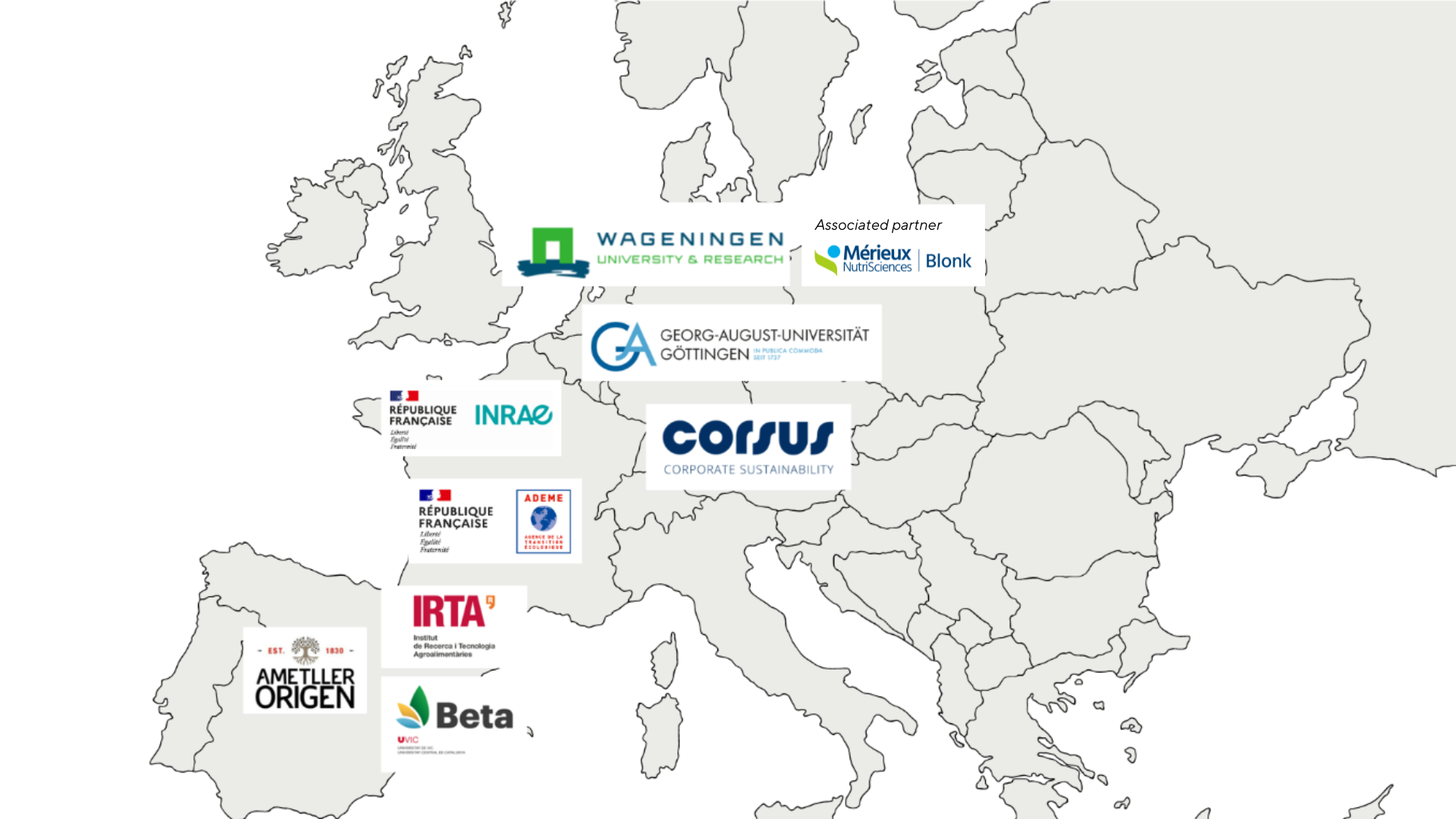
The consortium includes nine partners from France, Germany, the Netherlands, and Spain, combining expertise in life cycle assessment (LCA), environmental databases, food systems, data science, behavioural economics, and consumer research. By 2027, the project aims to deliver a validated and widely recognised European food environmental labelling framework to the European Commission, supporting future food sustainability labels across the EU.
Why Harmonising European Food Environmental Labelling Matters
Europe’s food system has a major environmental impact, contributing to greenhouse gas emissions, biodiversity loss, water pollution, resource depletion, and waste generation. At the same time, consumers increasingly expect transparent and trustworthy information about the sustainability of the food they buy.
Today, food environmental labelling systems and food ecolabelling initiatives vary significantly between countries and organisations across Europe. This fragmentation makes environmental information difficult to compare and limits the development of a consistent European approach.
The LIFE Eco Food Choice project addresses this challenge by developing harmonised methodologies and common standards for European food environmental labelling.
The project supports key European policy ambitions, including the European Green Deal and the Empowering Consumers Directive.
Drawing on existing national initiatives such as France’s Ecobalyse, the project also facilitates knowledge sharing and methodological alignment between European countries.
What Will Change with European Food Environmental Labelling
The project aims to make environmental information on food products more reliable, understandable, and actionable for all stakeholders across the food value chain.
For Consumers
Consumers will benefit from clearer and more transparent food environmental labelling directly available on food products. Harmonised food sustainability labels and food environmental scores can help consumers make more sustainable food choices.
For Producers and Food Companies
The project provides harmonised methodologies and environmental data that can help producers, manufacturers, and retailers better assess and reduce the environmental impacts of their products and supply chains.
For Policymakers and Public Authorities
The methodologies and experimental results generated through the project can support future European policies and initiatives related to sustainable food systems, environmental transparency, and corporate sustainability reporting.
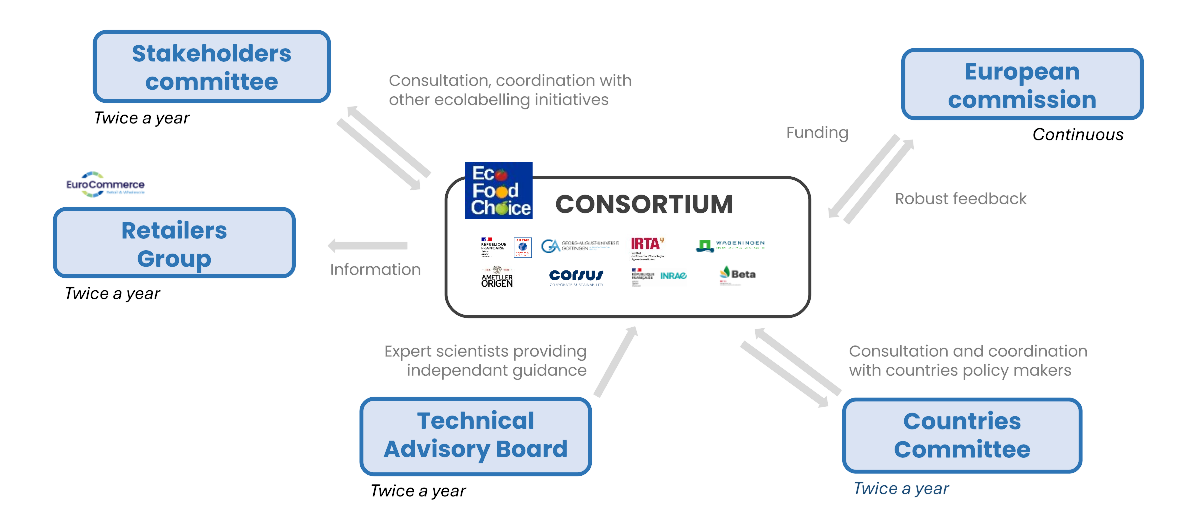
The Eco Food Choice consortium is connected to several committees to ensure all stakeholders are consulted throughout the project.
How the Eco Food Choice Project Works
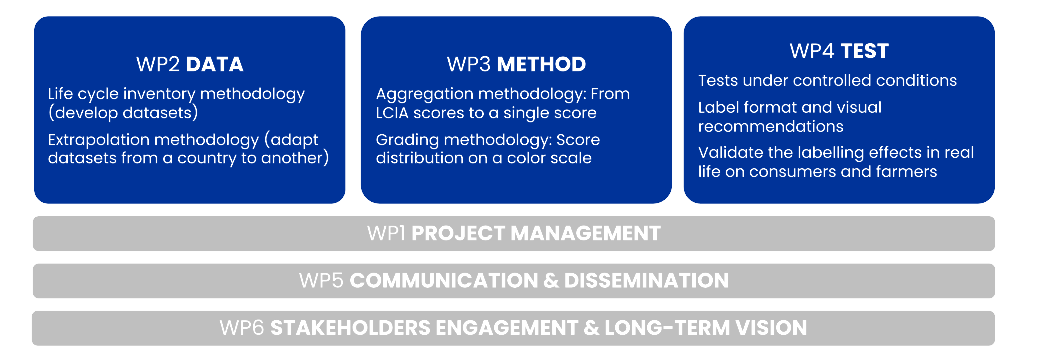
The LIFE Eco Food Choice project focuses on three complementary work streams.
Developing Harmonised LCA Methodologies
- The project develops a common European methodology for the development of food Life Cycle Inventories (LCI). These harmonised methods aim to improve consistency, interoperability, and scientific robustness across national environmental databases.
- The work builds on the Product Environmental Footprint (PEF) framework while addressing the specific needs and complexity of food systems.
- It is led by IRTA (Institute of Agrifood Research and Technology) in Catalonia.
Creating a European Food Environmental Score
- The project develops a standardised European food environmental score that aggregates multiple environmental indicators into a single sustainability score for food products. This environmental scoring methodology supports more transparent food environmental labelling across Europe.
- This work stream aims to create a transparent and scientifically robust scoring methodology that translates complex environmental impacts assessments into simple food sustainability information.
- It is led by WUR (Wageningen University and Research) in the Netherlands.
Testing Food Environmental Labels in Real-life Conditions
- The project evaluates food sustainability labels in supermarkets, canteens, laboratories, and online shopping environments across France, Germany, Spain, and the Netherlands.
- More than 90,000 consumers will participate in behavioural experiments and field tests.
- The experiments aim to assess:
- Consumer understanding
- Purchasing behaviour
- Trust in environmental information
- Potential impacts on food systems and production practices*
- It is led by UGOE (The University of Göttingen) in Germany.
Eco Food Choice Timeline and Progress
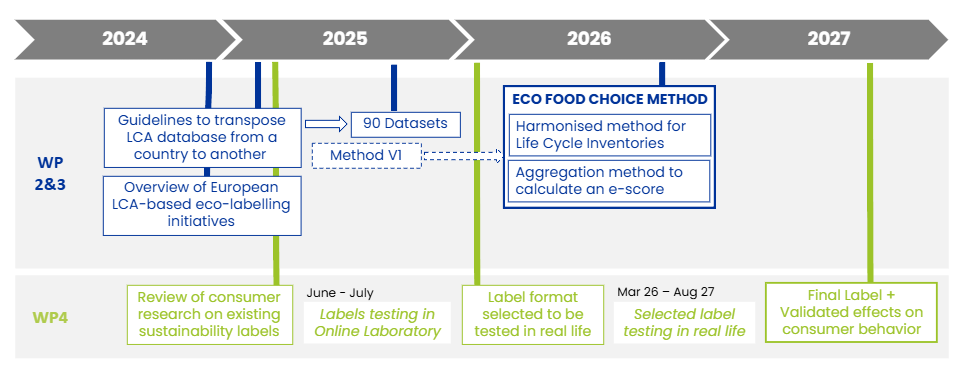
2023
- Launch of the LIFE Eco Food Choice project.
2024
- Initial methodological development and stakeholder engagement activities.
- Publication of the State-of-the-art Analysis of Food Ecolabelling Schemes in Europe.
2025
- Publication of the Extrapolation Method for National Food LCA Databases.
- Public consultation on the beta version of the European Harmonisation LCI & Scoring Methodology.
- Tests under controlled conditions to identify ‘best’-performing environmental label format.
2026
- Publication of the Market Analysis and Consumer Insights Report.
- Real-life tests in supermarkets, canteens and online shops to assess the impact of the environmental label on consumers’ behaviour.
2027
- Submission of a harmonised, validated and recognised European LCI & scoring ecolabelling methodology to the European Commission.
Eco Food Choice Deliverables & Resources
European Harmonization LCI & Scoring Methodology
Comprehensive guidelines for developing LCIs and calculating aggregated environmental scores. It builds on the PEF (Product Environmental Footprint) framework while providing practical solutions for the food sector.
Status: The document is currently in the ‘Beta’ version. A public consultation took place in September and October 2026. The final version is due to be published in November 2026.
State-of-the-art of Food Ecolabelling Schemes in Europe
A detailed overview of the 16 most relevant ecolabels in Europe, evaluated against 40 rigorous criteria by Wageningen University & Research (WUR).
Extrapolation Method for National Food LCA Databases
Methodological guidance on adapting national food LCA databases, such as Agribalyse, to other European countries and regional contexts.
Market Analysis and Consumer Insights Report
Developed by the University of Göttingen, this report analyses how environmental labelling can guide consumers toward more sustainable food choices in France, Germany, Spain, and the Netherlands, based on more than 250 scientific studies.
Our Webinar Replays
June 2026: Food Environmental Labels & Consumer Behaviour
May 2025: European Panorama of Food Ecolabelling
April 2024: General Introduction on Eco Food Choice
Let's meet!
Meet us at LCA FOOD 2026!
Meet us at LCA Food 2026 in Montreal. Join our strategic workshop on harmonizing food ecolabelling methodologies in an international context. It will take place on Monday, October 12, 2026, from 1:30 PM to 5:00 PM.
Get involved in Eco Food Choice
Follow European developments in food environmental labelling
The LIFE Eco Food Choice project actively collaborates with researchers, policymakers, food companies, retailers, and civil society organisations across Europe.
Follow the project on LinkedIn to stay informed about:
- New deliverables and publications
- Public consultations
- Events and webinars
- Experimental results
- European developments in food environmental labelling
Follow us on LinkedIn.
Any question about Eco Food Choice?
Contact our Project Manager: [email protected]